Soot in the Sump: The Fuel a Short-Hop Van Burns Cleaning Its Own Filter
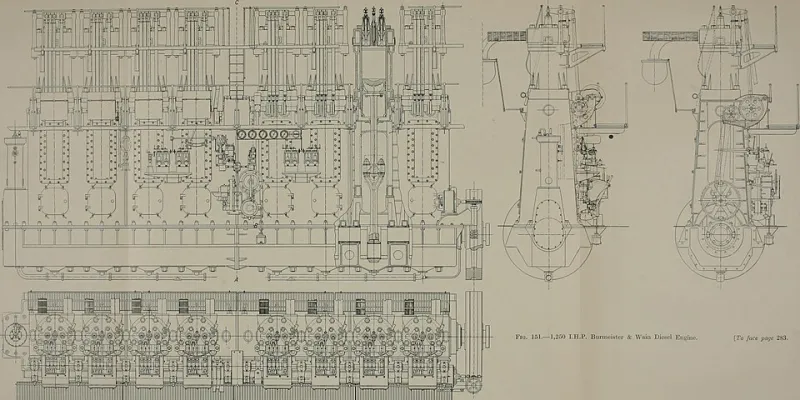
Photo: Chalkley, Alfred Philip, No restrictions, via Wikimedia Commons
There is a particular kind of urban depot where every van returns to the yard having covered eleven miles and made nineteen stops. The drivers are efficient, the routes are tight, and the fuel cards are quietly absorbing a cost that appears on no route sheet: the van is spending part of every week burning diesel to clean its own exhaust.
What the filter is doing, and why it needs fuel to do it
A diesel particulate filter traps soot. To burn that soot off, the filter needs to reach roughly 600 degrees Celsius. On a motorway run the exhaust gets there on its own, which is passive regeneration and costs almost nothing. On short urban work it never does. The engine control unit therefore takes over and initiates an active regeneration: it injects extra diesel, sometimes into the cylinder late in the combustion cycle and sometimes straight into the exhaust stream, to raise temperature deliberately.
On depot-heavy duty cycles an active regeneration can occur every 250 to 500 miles, last ten to twenty-five minutes, and interrupt an otherwise efficient fuelling strategy. Some cycles complete. Some are abandoned when the driver parks up and switches off, and the soot load simply waits for the next attempt.
The direct fuel penalty, priced honestly
This is the smaller half of the story, and it is worth saying so plainly rather than inflating it.
Take a van covering 18,000 miles a year on urban rounds at about 30 mpg. That is roughly 2,700 litres annually. An active regeneration typically consumes somewhere between 0.3 and 0.8 litres of additional fuel per event, and the enriched running during the cycle adds a little more. Across a year of short-hop work, the total drag commonly lands at 1.5-3% of annual consumption: somewhere between 40 and 110 litres per van.
At 145p a litre that is £60 to £160 per van per year. Across thirty vans, perhaps £2,000 to £4,800. Real money, but not the number that ruins a transport budget. The number that ruins a transport budget is everything downstream of it.
The costs that follow the fuel
Oil dilution. Diesel injected late in the cycle can wash past the piston rings into the sump. Over a winter of short runs the oil level on the dipstick can climb rather than fall, and the oil thins. A fleet that moves half its short-hop vans onto an interim oil change is looking at £150-£200 a van, plus the wear that diluted oil accelerates.
Forced static regeneration. When the soot load climbs past the point where a road cycle will clear it, the van goes to a workshop for a static regeneration. Expect £150-£350, plus a day off the road and a standing cost of £150-£300 for the substitute vehicle. Two or three of these across a depot in a single year is common where route mix is poor.
Filter replacement. A neglected filter that has cracked or loaded with ash beyond recovery costs £1,200-£2,500 to replace, before fitting.
Reduced power and missed service levels. A van that drops into limp mode halfway through a round is a missed delivery window and a phone call from a client, not a workshop invoice. That cost lands on the operations side of the business and rarely gets attributed to the filter.
Reading the warning signs early
Most of these appear before the dashboard light, and all of them are visible to a fleet manager who knows to look.
- The cooling fan runs for several minutes after the engine is switched off, or a hot, acrid smell hangs around the van.
- Idle speed sits high at around 1,000 rpm when the van is stationary.
- An exhaust filter message asks the driver to keep driving at speed.
- The oil level rises between services, or the oil smells of diesel.
- Recorded fuel consumption creeps upward with no change in route or load.
- The gap between regenerations shortens month on month.
- Coolant temperature never settles at normal, which usually means a thermostat is holding the engine cold and passive regeneration out of reach.
What telematics shows that the workshop laptop cannot
A dealer can read soot mass and regeneration history from one van on one day. Telematics can rank the whole fleet across a year, and the ranking is rarely a surprise to anyone who has looked at the routes.
Pull the following by vehicle and by month: share of journeys under five miles, longest single journey of the week, time spent above 40 mph, stop-start events per mile, idle minutes per day, cold starts per day, and average coolant temperature where the CAN feed supports it. Build a simple regen risk score from those fields and sort the fleet. The top decile will contain almost every van that eventually lights up the dashboard, and it will usually contain the vans whose drivers have the tightest, most fragmented rounds.
A route review checklist
- Identify every van whose longest weekly journey is under 20 miles.
- Check whether each of those vans gets one sustained run of 25-30 minutes above 50 mph each week. If not, build one into the schedule.
- Examine load factors. Consistently light loads keep exhaust temperatures low; consolidating drops onto fewer, fuller vans helps twice over.
- Trim excessive idling at loading bays, which cools the exhaust and lengthens warm-up.
- Review whether the shortest rounds could be served by a smaller van or a light electric vehicle.
- Confirm that morning starts are not a queue of cold engines doing two-minute shunts between bays.
- Check workshop records against the telematics ranking and look for vans with repeated interim oil changes.
- Re-run the ranking quarterly, because depot work changes quietly.
The driver briefing, kept short
The briefing that works is the one a driver can repeat back in the yard, not the one in the laminated folder.
- If the fan keeps running or the filter message appears, let the cycle finish before switching off where it is safe to do so.
- Do not interrupt a regeneration by stopping for a cigarette break halfway through it.
- Report the filter light rather than driving on it for a fortnight.
- Report a rising oil level, not just a falling one.
- Do not overfill the oil; excess oil can damage the filter and the engine.
- Use the correct low-SAPS oil specified for the van, not whatever is in the drum at the back of the workshop.
- Take the long way back once a week when the schedule allows it. That single habit is the cheapest regeneration strategy available.
Maintenance that earns its keep
Regeneration problems are often symptoms. A failing thermostat prevents passive regeneration entirely. A leaking boost hose, a clogged air filter, a tired mass airflow sensor or a persistent EGR fault all increase smoke loading and shorten the interval between cycles. Fuel quality matters too, particularly for depots running bulk tanks where water and contamination accumulate quietly. And no amount of maintenance will rescue a van whose duty cycle never lets the exhaust get hot.
Removing the filter is not a solution. It is an MOT failure, it is unlawful for road use, and it leaves the underlying route problem untouched while shifting the emissions onto the street outside the depot.
The honest long-term answer
For the shortest duty cycles, a diesel van is simply the wrong tool. Electric light commercial vehicles handle 60-80 mile urban days comfortably, have no filter to regenerate, no oil to dilute and a lower pence-per-mile figure on the right tariff. Where electric is not yet viable, a scheduled weekly A-road run and a route review will cost far less than a workshop visit and a day off the road.
The fuel burned in regeneration is the visible part of the bill. The invisible part is the disruption it causes, and that is what a fleet manager should be measuring.