The Cheapest Pump Is Not Always the Cheapest Mile: Routing Fuel Stops for UK Fleets
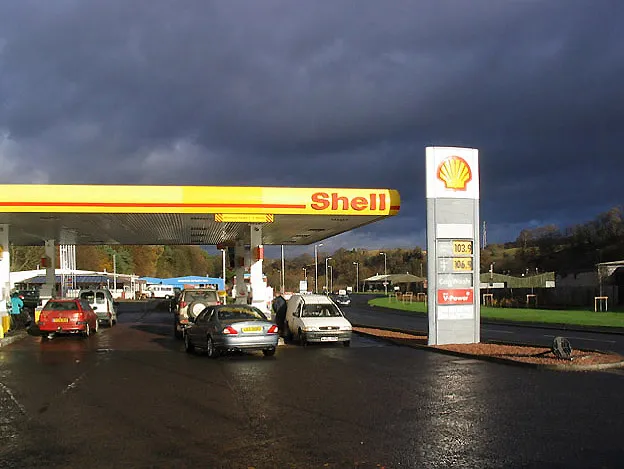
Photo: Walter Baxter, CC BY-SA 2.0, via Wikimedia Commons
Forecourt price boards are designed to be read at speed. A fleet manager needs a slower number: the cost per litre delivered to the wheel, not the cost per litre at the nozzle. Within a few miles of a depot, diesel can move by 15p to 20p a litre. On a 70-litre fill that is £10.50 to £14.00 — enough to matter, but rarely enough to justify a ten-mile detour in a 30mpg van. The discipline is to separate a genuine route saving from a price-chasing habit.
Start with the true cost of a detour
The first calculation is not the pump price. It is the cost of going there. For a light commercial vehicle, use a simple break-even sum: extra miles divided by miles per gallon, multiplied by 4.546 to convert to litres, multiplied by the pump price. Add the driver time at your fully loaded hourly cost. Add any toll or parking charge. Subtract that total from the saving on the fill.
A worked example makes the point. A van returns 30mpg. The cheap forecourt is eight miles off the usual route, adding sixteen miles in total. At £1.45 a litre, the detour fuel costs about £3.52. Twenty minutes of driver time at £18 an hour adds £6.00. The true cost of the stop is £9.52 before the fill begins. If the site is 20p cheaper and the van takes 60 litres, the nozzle saving is £12.00. The net gain is £2.48 — real, but thin. If the tank is half full, or the driver queues for ten minutes, the case disappears.
Map the catchment, not the whole county
A fuel route should be built around three geographies: the depot, the regular delivery or service routes, and the overnight parking locations. Plot the forecourts that fall within a realistic corridor — typically five to eight miles from the depot or directly on a repeated route. Do not build a map of every cheap site in the region. A site that is excellent for a Monday run to Leeds may be irrelevant for a van that never leaves Southampton.
Separate the forecourts into three commercial groups. Supermarket sites are usually sharp on headline price but can be tight for larger vehicles, busy at peak times and limited on card acceptance. Motorway services carry a convenience premium and should be treated as an emergency or time-critical option, not a default. Independent forecourts can be competitive, particularly in urban areas, but the price board may not tell the whole story once card fees, minimum fills or restricted hours are considered. The fuel card network matters as much as the pump price.
Put the fuel card terms beside the price board
A fuel card price is not the same as the advertised forecourt price. Check the weekly or daily rate, the site fees, the out-of-network charges and the VAT treatment. A card that is 2p a litre cheaper on paper can lose that advantage on a single out-of-network fill. For each nominated site, record the card price, the retail price, the site fee and the payment terms. The comparison should be like-for-like: pence per litre delivered, not pence per litre advertised.
Tank size changes the arithmetic. A 70-litre van filling from a quarter tank takes about 52 litres. A 20p saving is £10.40. A 900-litre tractor unit taking 650 litres sees a £130 saving on the same gap, which can justify a longer detour — but only if the route and driver hours allow it. Do not apply a van policy to a heavy truck, or the reverse.
Use transaction data to prove the gain
A route map is a hypothesis. Fuel card data is the evidence. Export at least 90 days of transactions by vehicle, site, date, time, litres, price per litre and odometer. Match each fill to the planned route. Flag fills that took place outside the nominated network, fills that occurred within 50 miles of a cheaper nominated site, and fills that were unusually small. Small, frequent fills often signal convenience buying rather than cost control.
Then calculate the net saving for a trial period. Take the litres bought at the nominated site, multiply by the price difference against the previous baseline, and subtract the detour fuel and driver time. If the trial covers ten vans over eight weeks, the result will be robust enough to decide whether to keep, adjust or abandon the route. Avoid claiming a saving based on the price board alone; the audit should show the net figure after the cost of getting there.
Set rules that drivers can follow
A fuel route fails when it depends on a driver making a complex calculation at the end of a shift. Give them a short nominated list: primary site, backup site, emergency site. Set a minimum fill size where practical, and make clear that safety, delivery windows and driver hours override a penny or two at the pump. Do not introduce a bonus scheme that rewards cheap fills without accounting for detour miles; it will encourage exactly the behaviour the route is meant to prevent.
Review the list quarterly. Forecourt prices move, card networks change and routes are redesigned. In 2026, with fuel margins under pressure and telematics data more accessible than ever, the fleets that control cost are not necessarily those with the most aggressive fuel card. They are the ones that know when a cheap pump is genuinely cheap — and when it is simply a more expensive way to save 20p.